
A fair value gap (FVG) is one of the most popular ideas in ICT and Smart Money trading, and one of the most misused. This guide explains what a fair value gap is, why it forms, and how to use one on gold (XAUUSD) without falling into the traps that catch most traders. It also shares what we learned from testing FVG-based rules on more than 98,000 M15 gold candles.
- What a fair value gap is
- Why FVGs form
- Bullish vs bearish FVGs
- Five mistakes traders make with FVGs
- What the data says
- A practical checklist
What is a fair value gap?
A fair value gap is a three-candle pattern where the middle candle moves so aggressively that the wicks of the first and third candles don't overlap. The empty space between them is the gap. In a bullish FVG, the low of candle three sits above the high of candle one. In a bearish FVG, the high of candle three sits below the low of candle one.
That gap marks a price range where the market traded in only one direction. Buyers or sellers overwhelmed the other side so quickly that very little two-way business happened there.
Why fair value gaps form
Large participants can't fill big orders at a single price. When a bank, fund or large algorithm needs size, it takes liquidity aggressively and moves price quickly. What's left behind is an imbalance: a zone where one side's orders were only partly filled. When price later returns, those resting interests often defend the level, which is why price frequently reacts at or inside an old FVG.
Bullish vs bearish FVGs on XAUUSD
Gold is well suited to imbalance trading. It moves in sharp, news-driven bursts, often during the London and New York sessions, and those bursts leave clean gaps on the 15-minute to 4-hour charts. A bullish FVG below current price is a potential demand area, and a bearish FVG above price is a potential supply area.
Five mistakes traders make with FVGs
- Trading every gap. Gold prints dozens of FVGs a week on lower timeframes. Most are noise. A gap with no higher-timeframe context is a coin flip.
- Entering on the first touch. Price reaching a gap proves nothing. Without a sign that the area is being defended, you're catching a falling knife.
- Stops that are too tight. Placing the stop just beyond the FVG candle feels efficient because the reward-to-risk looks huge. In our gold testing, the tightest stop placements cut the edge by more than half and roughly doubled drawdowns, because normal M15 noise of $3–10 simply takes them out.
- Ignoring invalidation. When price closes decisively through a gap, the imbalance has been absorbed. Treat it as gone.
- No exit plan. Traders obsess over entries and improvise exits. In our research, exit rules changed four-year results by more than any entry filter.
What the data says
We built and tested a fully rule-based gold model around imbalances over July 2022 – September 2026, with spread and slippage charged on every trade. Three lessons stood out:
- Context beats the pattern. Raw FVGs on their own weren't enough. Results improved sharply once higher-timeframe context and a lower-timeframe confirmation were required.
- Confirmation pays for itself. Waiting for a market structure shift after price reacts at a gap filtered out most failed setups.
- Wider, logical stops won. Stops placed where the idea is proven wrong, beyond the structure rather than just beyond a candle, gave the best balance of return and drawdown.
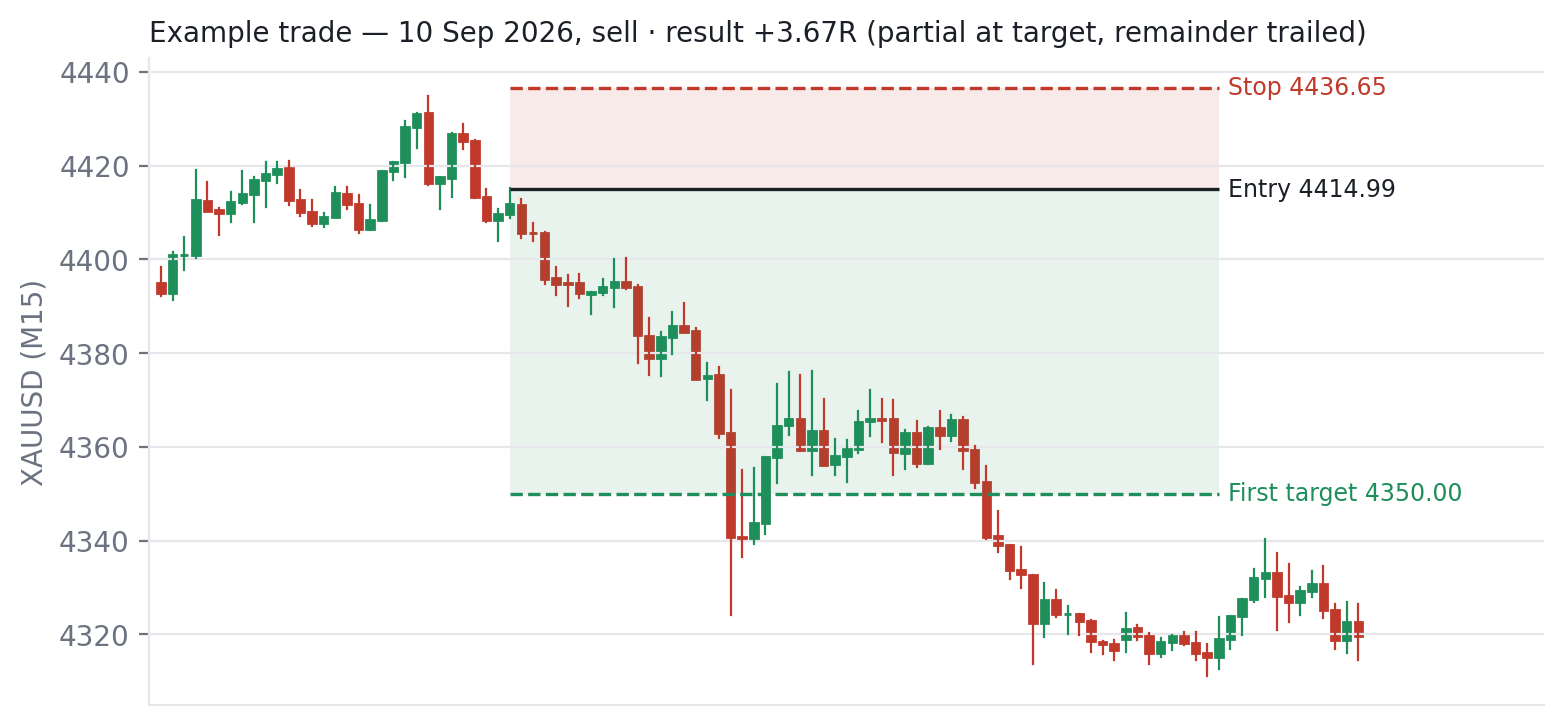
The finished model produced +91R over 146 trades with a profit factor of 2.71 and a maximum drawdown of 6.3R in backtesting. You can see every year and month on the performance page.
A practical FVG checklist
- Is the gap on a meaningful timeframe (M15 or higher for gold)?
- Does higher-timeframe context agree with the direction?
- Has price shown a reaction, not just a touch?
- Has lower-timeframe structure shifted in your direction?
- Is your stop where the idea is wrong, not where the loss feels small?
- Do you know where you'll take partial profit, and how you'll manage the rest?
A fair value gap tells you where to look. It doesn't tell you when to act.
Trade the tested model
Use the same rule set as live signals, an MT5 indicator or a fully automated MT5 EA.
Figures in this article are hypothetical backtest and simulation results. Trading involves substantial risk. This is educational content, not financial advice. See the risk disclosure.